How ePayment works with freestanding cards
Install AI tools
Give your assistant up-to-date guidance for our APIs, with our plugin or without it.
The plugin is still under development. See the AI tools page for details.
- Claude Code
- Cursor
- Codex
- Without installing
Run both commands, in order.
claude plugin marketplace add vippsas/agent-toolkit
claude plugin install vipps-developer@agent-toolkit
Open Settings, then Plugins.
Add vippsas/agent-toolkit as a plugin marketplace, then install the "vipps-developer" plugin.
For the app, add the marketplace "vippsas/agent-toolkit" and then install "vipps-developer". For the CLI, run the following commands.
codex plugin marketplace add vippsas/agent-toolkit
codex plugin add vipps-developer@agent-toolkit
Paste this into any assistant.
Read https://github.com/vippsas/agent-toolkit/blob/main/plugins/vipps-developer/README.md for Vipps MobilePay integration guidance.
For troubleshooting, see the full instructions.
This is how card payments in web shops or merchant websites work with the ePayment API, where the customer pays with a card instead of the Vipps or MobilePay app.
Details
1. Customer selects their payment method
On the checkout page of a merchant's website or app, the customer chooses to pay with a card.
- Vipps
- MobilePay
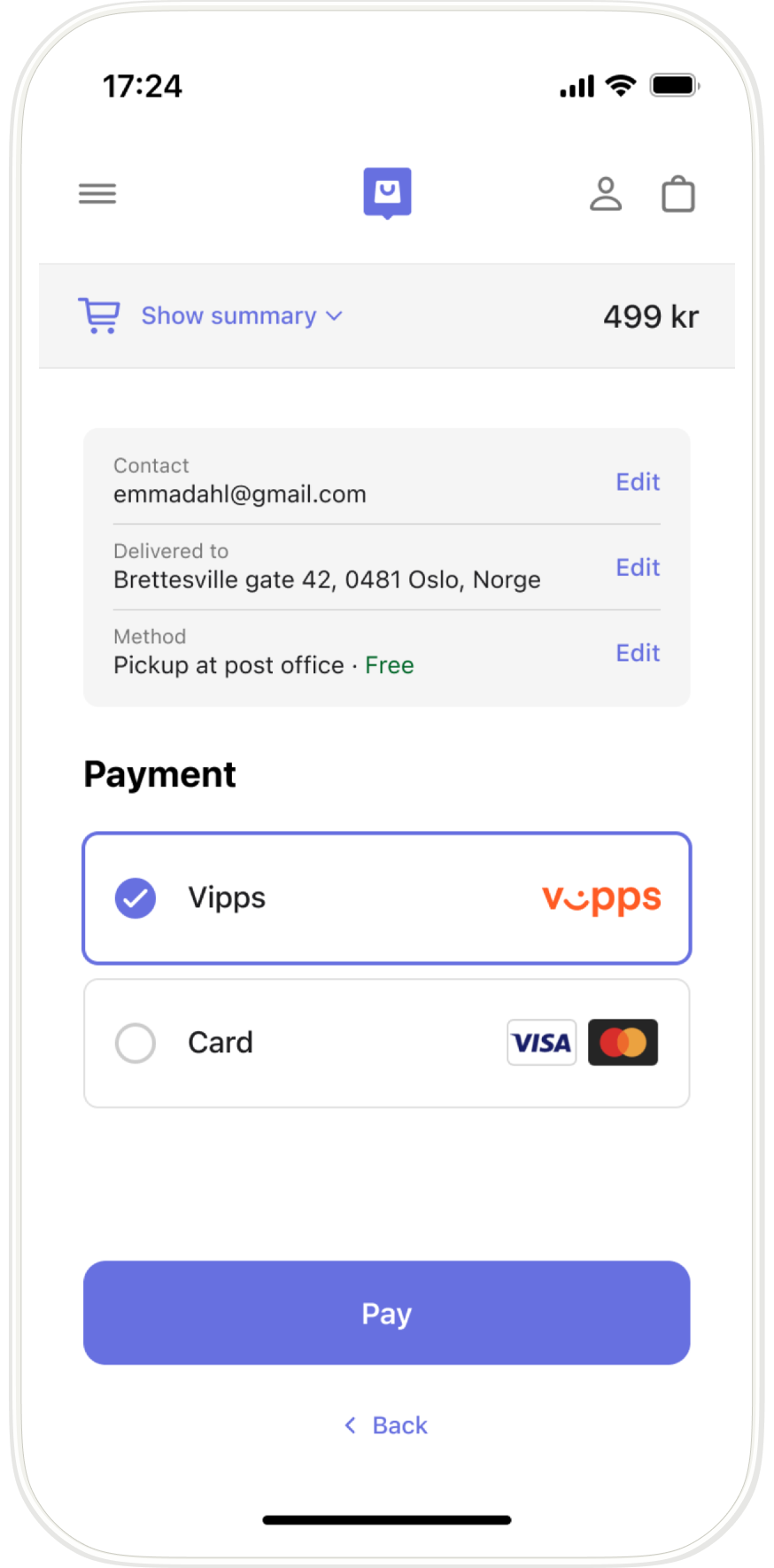
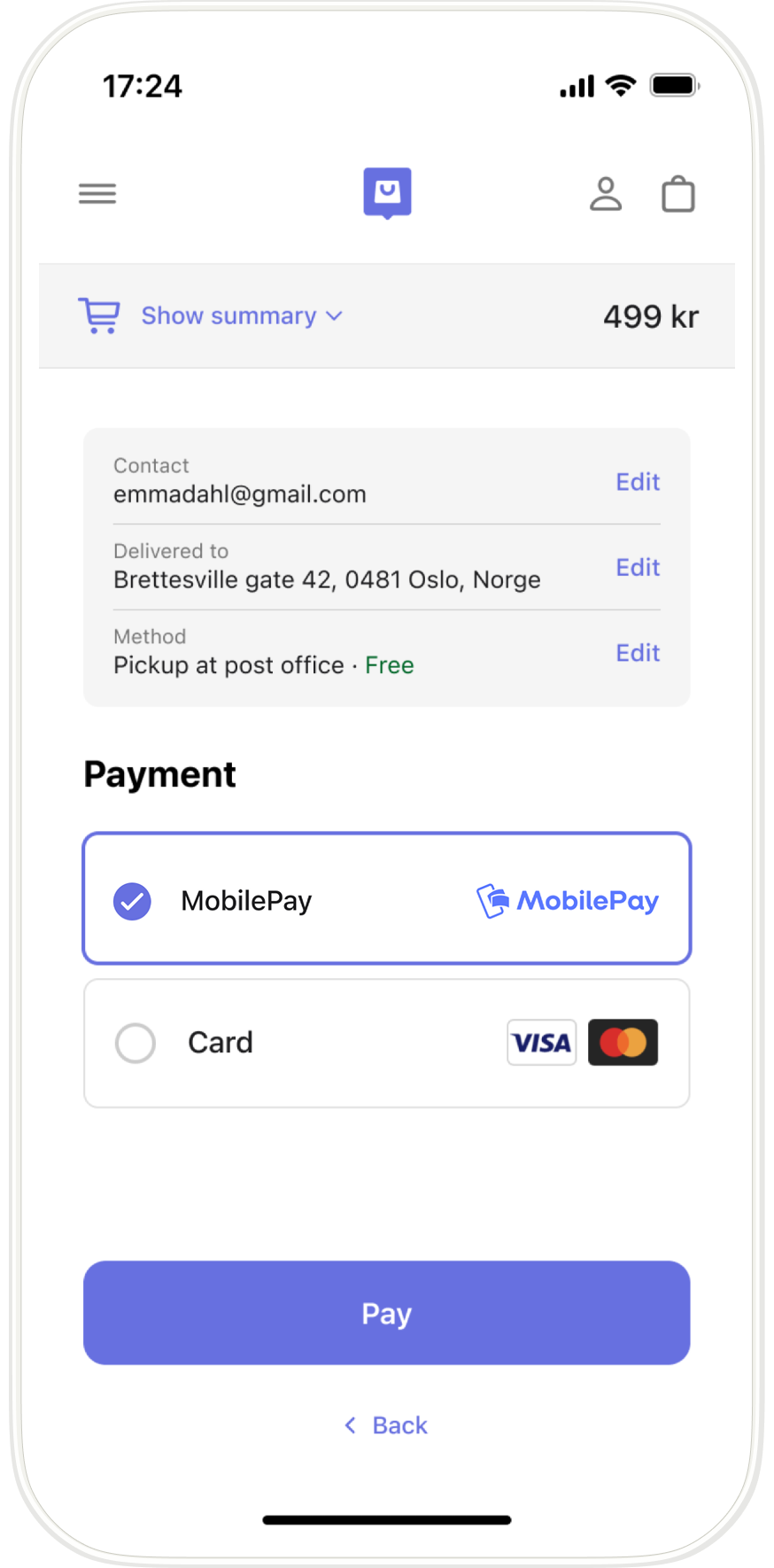
Screenshot: Mobile checkout payment method selection showing the app brand (Vipps or MobilePay) alongside Card as an alternative option.
2. The merchant creates a payment request
The merchant initiates a freestanding card payment with
POST:/epayment/v1/payments, specifying
"paymentMethod": {"type": "CARD"}, "userFlow": "WEB_REDIRECT", and a returnUrl.
The response contains a redirectUrl pointing to the card entry page. Send the customer to that URL to start the
payment.
For a full example, see ePayment Features: Freestanding cards.
3. Customer enters card details
The card entry page opens, where the customer enters their card details and pays.
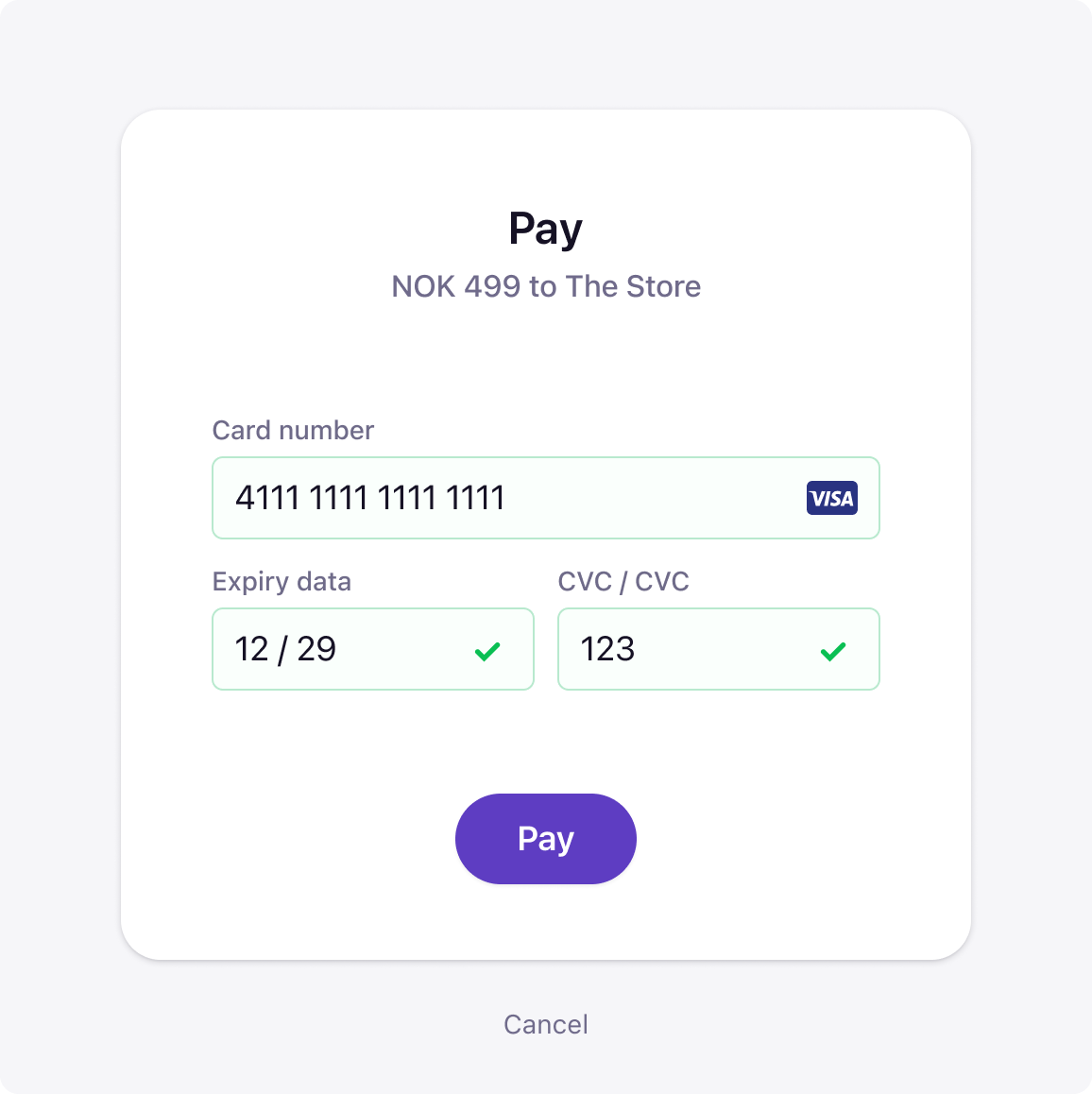
Screenshot: Card payment entry form with fields for card number, expiry date, and CVC, with a Pay button.
When the customer submits the card details, they are redirected back to the returnUrl.
The card entry page is not currently available in the test environment.
4. The merchant learns the outcome from webhooks and polling
The merchant's system has no visibility into what happens on the card entry page, so it must subscribe to webhooks to be notified when the customer acts on the payment. Register the webhook with the Webhooks API before creating the payment, so that no event is missed while the customer is paying, and subscribe to all three outcomes:
epayments.payment.authorized.v1: the customer completed the card payment.epayments.payment.aborted.v1: the customer canceled the payment.epayments.payment.expired.v1: the customer did not complete the payment in time, 10 minutes by default.
If the payment is aborted or expires, the order remains unpaid and the customer is returned to the checkout page,
where they can try again or select another payment method. Subscribing to epayments.payment.authorized.v1 alone
leaves such orders waiting for a payment that will never arrive.
Webhooks can be delayed or missed, so do not rely on them alone. Back them up by polling
GET:/epayment/v1/payments/{reference}
for the payment state, following the polling guidelines:
start after 5 seconds, then check every 2 seconds.
5. The merchant's shop confirms the order
On successful payment, the merchant's store page or app opens, and the order is confirmed.
- If the payment was started on a mobile device, the store page or app will open again and confirm that the order was successful.
- If the payment was started on a desktop device, the customer can go back to the webpage, which confirms that the order was successful.
6. The merchant completes the order and shipping
The merchant completes the order and ships it to the customer.
7. The merchant captures the payment
Authorization only reserves the amount. Capturing the payment is what transfers the funds, so the merchant
captures once the order is ready to ship, using
POST:/epayment/v1/payments/{reference}/capture.
The funds are then transferred to the merchant's account. This may take 2 or 3 days, depending on the bank.
Sequence diagram
Freestanding card payment flow
- Customer selects card as the payment method.
- Merchant initiates a payment request via the ePayment API with the card payment method.
- ePayment API returns the redirect URL to the card entry page.
- Merchant sends the customer to the card entry page.
- Customer enters the card details and pays.
- Webhooks API sends the merchant an authorized, aborted, or expired event.
- Merchant gets the payment from the ePayment API, as a backup if the webhook is delayed or missed.
- ePayment API returns the current state of the payment.
- If the payment was aborted or expired, the customer is returned to the checkout page and the flow ends.
- If the payment was authorized, the merchant displays order confirmation to the customer.
- Merchant prepares the order (packs goods, makes ready to dispatch).
- Merchant captures the payment via the ePayment API.
- ePayment API returns a response with the captured amount.
- Merchant verifies the captured amount matches expected before shipping.
- Merchant ships the order (only after full capture is verified).
More details
For more details, see ePayment Features: Accept freestanding card payments.